

CASE 022: ON SOCCER AND THE GOOD LIFE: AN OP-ED FOR UNIS-MAG
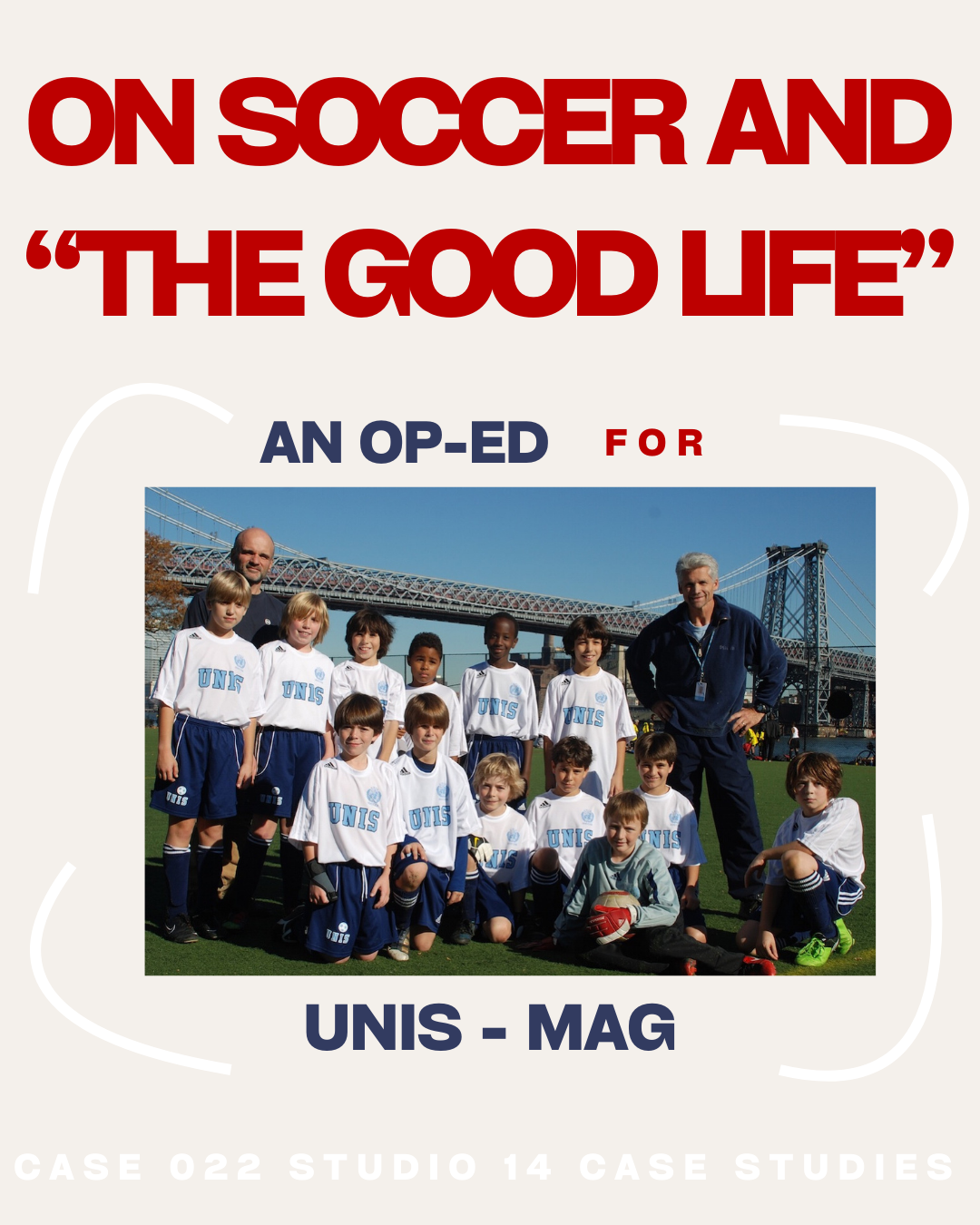
CASE 022: ON SOCCER AND THE GOOD LIFE; AN OP-ED FOR UNIS-MAG
CASE 022: ON SOCCER AND “THE GOOD LIFE”
The year is 2005, and your greatest worry is accidentally kicking the ball over a fence into the East River. To put it simply, you are living “the good life”. Give me Aristotle, give me Socrates, give me Plato, and the Stoics. I’ll give you a silly little game where people kick a ball around that could teach you just as much about the good life.
Plato was pretty insistent that the good life required a “harmonious order of the soul, led by reason and cultivated through virtue.”
In the first grade, I remember a young boy joining our class. He and his mother had moved to New York from Tokyo for her work with the United Nations. He didn’t speak a word of English. Leaving his father, relatives, and friends behind, the young boy carried a sense of conflict with him that I can only identify now with the benefit of two decades of hindsight. He spoke without being heard. He cried with unmistakable longing. It didn’t take a rocket scientist to know that what he was experiencing was tough. Tough for a six-year-old, tough for a sixty-six-year-old. A passing fly on the wall of his life, I never had the privilege of truly knowing him.
But, I did see him.
Even at the age of six, at a school like ours, you knew that when someone floated on their toes, bounced from foot to foot, on legs as bowed as a stag’s horns in December - a kid could play ball. After a week of silence and tense stillness, the young boy walked to the concrete parking lot next to the playground. Without saying a word, his face declared he was ready to hop in.
There were two rules to lunch-time soccer. You were on one team or the other, and you better not kick that damn ball over the fence. The young boy joined a team, threw his hands up asking for a pass, and he was off to the races. He danced through the swarms of eager first-graders and scored a goal I still remember to this day. Absorbed by the love and adoration in his team’s celebrations, I saw him smile for the first time. I saw a sense of peace in his eyes - the way it must have been on the playgrounds back home in Tokyo. Was it “a harmonious order of the soul, led by reason and cultivated through virtue.” Hell, do I know? I was six! What I do know is that it was that moment that I truly fell in love with the game of soccer.
“He who is not content with what he has, would not be content with what he would like to have.” - Socrates.
Like any self-respecting football fan, I mark the years in my life by the major football tournaments. Your World Cup years. Your European Championships. Your Champions League finals. In the Autumn of 2010 (the year of the South African World Cup), Juan De Rosa (then Boys High School Varsity Soccer Head Coach) was quoted in a local publication as saying, and I’m paraphrasing here, “our school always wins because these kids play from kindergarten to their teenage years together, on the playgrounds, and in the streets.” He was referring to a unique type of familial bond that is forged by a shared emotional, physical, and integrated life experience.
The year of the South African World Cup was a big year for me personally. It was the year that my best friend’s father, Pepe, told me they were moving back to Italy come summer’s end.
Desperation and despair are words I don’t use casually, and still, I don’t think they quite capture the weight of my downward emotional spiral in that moment. A tall, handsome man, with greying hair and an accented voice as smooth as countryside air on a Spring morning, Pepe had a way of making it always seem as though there was no crisis too large to solve. Unsurprisingly, he was one of Italy’s best attorneys.
After consoling his son for weeks following the news, Pepe now had to deal with me. The +1 he didn’t budget for, but seemed always to be living in his home, Pepe treated me as his own. He taught me the family tradition of watching their beloved Inter Milan every weekend as his club battled to decide whether this would be a great week for my Italian family, or one full of sorrow. For 90 minutes every weekend, we convened as a family. Eyes cast on the television. Couches were jumped on, coffee was spilled. It was my favorite part of the week. It was pure. Communal. Love.
With a few tears in my eyes, Pepe reminded me that none of this was going away today, but I would need to accept one thing. The future doesn’t make promises; it only yields change. It was my first reckoning with real impermanence, and it was the kind that breaks your heart. That year, Inter Milan went on to win every major competition there was to win - a historic European, league, and cup treble. More than a few glasses were broken in the house, and everyone shed their fair share of tears of joy. Looking back on it today, it's far easier to fully appreciate the wabi-sabi of it all. Even still, in that moment, I found contentment with what I had, grateful for the bond forged around our favorite silly little game. A parting gift from my Italian family and the sport they held so dear; the lesson of love and presence in an evanescent world.
"Wishing to be friends is quick work, but friendship is a slow-ripening fruit" - Aristotle.
Fast forward 15 years. After a few stints in European academies, a fulfilling high school and college soccer career, and certainly more than ten thousand hours on the pitch, I still find myself clinging to this silly little game for all it has to offer. While my competitive boots may be hung up, I’ve forged a career on the business side of the game, working on behalf of FIFA on their World Cup property, and operating my own soccer media outlet, Studio 14 Case Studies. Contrary to what you may be thinking by now, soccer is not my entire life. I’m married, dedicated to winning the husband of the year award this year and every year. I run marathons because the discipline of training for something gives me peace of mind. I grow sprouts in my kitchen because I think they look and taste wonderful. My life’s flavors and experiences range far beyond the kicking of a ball. And still, I keep returning to this silly little game. Why? Is it the entertaining narrative of professional sport? Perhaps it's the distraction it brings from the heavier things in life? I’ve asked these questions for a while now, and I think I’ve landed somewhere that may scratch the surface of an answer.
Football, Soccer, the “global game”, may be the most ubiquitous through-line I’ll ever have to another’s life. As humans, we can connect on deep issues, elements central to the human experience. But not instantly. You aren’t going to stop a stranger in a park and ask them how their parents are. Or what their belief about love is. You likely won’t even ask how their week has been going. I don’t blame you. You’ve got a lot going on, and it’s daunting to start conversations with strangers. What if you said “hi” to someone and it was awkward? Yikes!
Now. Throw a ball on the floor, swing your leg back, and release. You just passed your way into someone's day. A conversation starter. An invitation to open your world and theirs. It may not always work, but this sport has always been my permission to say “hello”. Hello has always been my gateway to begin the ripening of the fruits of friendship. In some way or another, it's surely the same for you.
So once again, I ask of you: give me Aristotle, Socrates, Plato, and the Stoics.
Their beliefs and theories on what “the good life is” and how to achieve it may have varied, but I promise you, they would agree on one thing. When embraced in its dynamic and full capacity, this sport offers a medium to explore the most fulfilling elements of life. Whether it be finding harmony in a foreign land, presence in a shifting world, or the type of connection that turns strangers into your universe, this silly little game will always offer a guiding light in how we may navigate this earth.
My greatest worry may no longer be kicking the ball into the East River during recess, but I do my best to live as though it is. A central pillar of my philosophy on living, “the good life”.
